Recently, the National Glacier, Permafrost and Desert Scientific Data Center released and shared the Qinghai-Tibet Plateau permafrost distribution change dataset (1980-2018) based on map constraints. The dataset was completed by Professor Nan Zhuotong's team (PermaLab) of Shanghai Normal University and is open to users. Scientific researchers are warmly welcome to download and use it.
The spatio-temporal evolution of permafrost on the Qinghai-Tibet Plateau has a profound impact on regional hydrological cycles, ecosystem succession and climate feedback under the background of global change. However, limited by complex terrain and strong spatial heterogeneity, how to accurately characterize the historical and dynamic characteristics of permafrost has always been a major challenge in permafrost research.
Professor Nan Zhuotong's team (PermaLab) of Shanghai Normal University has developed a long-term time-series data set of permafrost distribution on the Qinghai-Tibet Plateau year by year with a spatial resolution of 0.1° and a time span of 39 years (1980 - 2018). In response to problems such as the difficulty in reflecting degradation dynamics in early space products and the limitations of traditional simulations to "single point calibration" deviations, this data product innovatively adopts the "Map-Based Parameter Calibration Strategy (CaliMAP)". This strategy takes the high-precision 2010 permafrost distribution map of the Qinghai-Tibet Plateau as the spatial constraint target, and uses the Bayesian optimization algorithm to deeply optimize 26 heterogeneity sensitive parameters in the improved Noah-Tibet land surface process model. Ensemble simulation was carried out by extracting 13 sets of optimal parameters.
The verification results show that the dataset has high accuracy in thermal state simulation, and the root-mean-square errors (RMSE) of active layer thickness (ALT), permafrost roof temperature (TTOP) and 10-meter depth ground temperature (GT10m) are 0.68 m, 0.41 ℃ and 1.30 ℃ respectively. The RMSE of ALT change rate is as low as 0.08 m/10a, which fully demonstrates its reliability in capturing multi-year intergenerational evolution trends.
The dataset reveals the evolution characteristics of plateau frozen soil between 1980 and 2018:
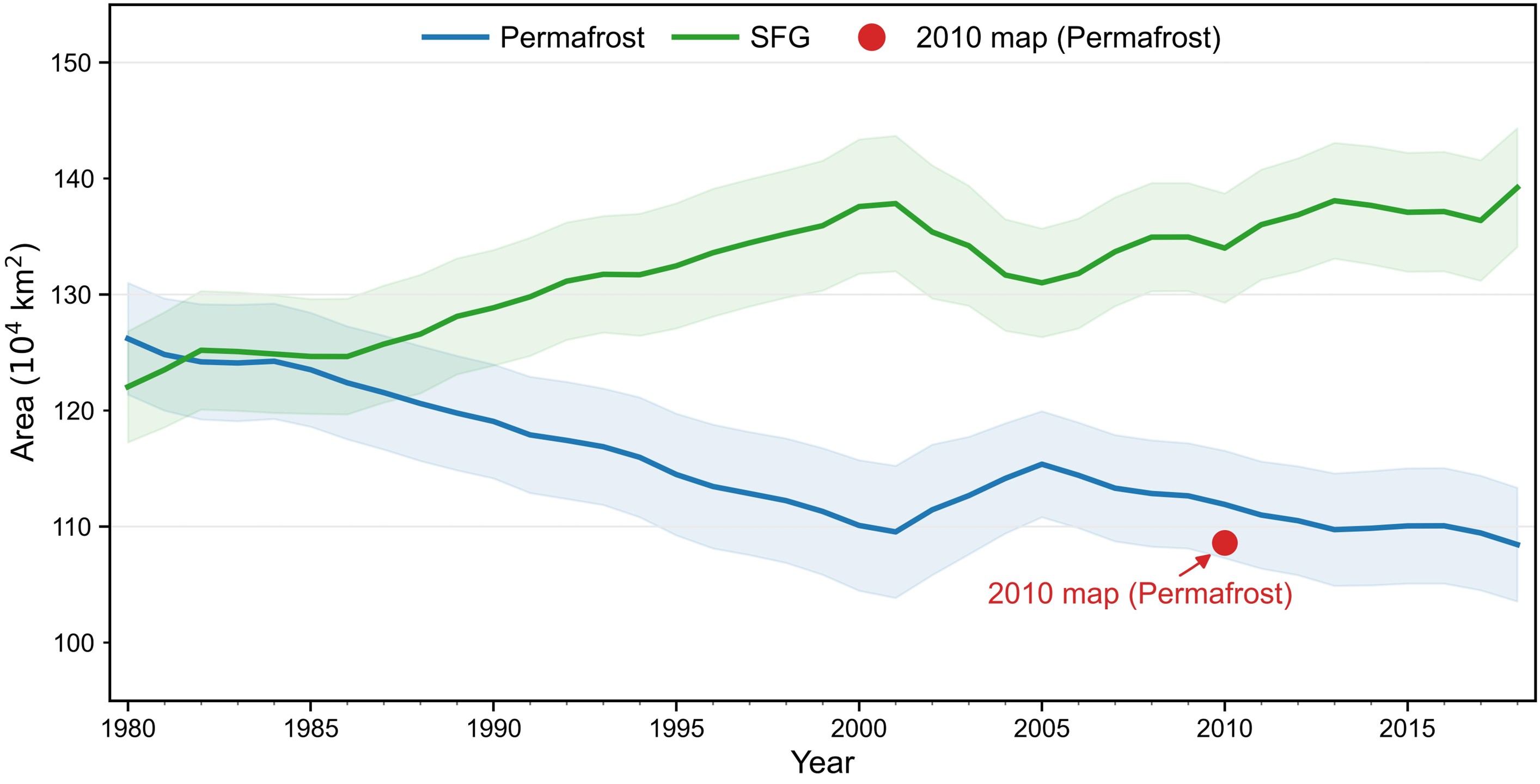
1. Overall trend: The area of permafrost continues to shrink, which has a significant inverse relationship with the expansion of seasonal permafrost. In the past 40 years, the total area of permafrost has decreased from approximately 1.262 million km2 to 1.085 million km2, with a cumulative loss of approximately 177,000 km2, and an average degradation rate of 44,400 km2/10a.
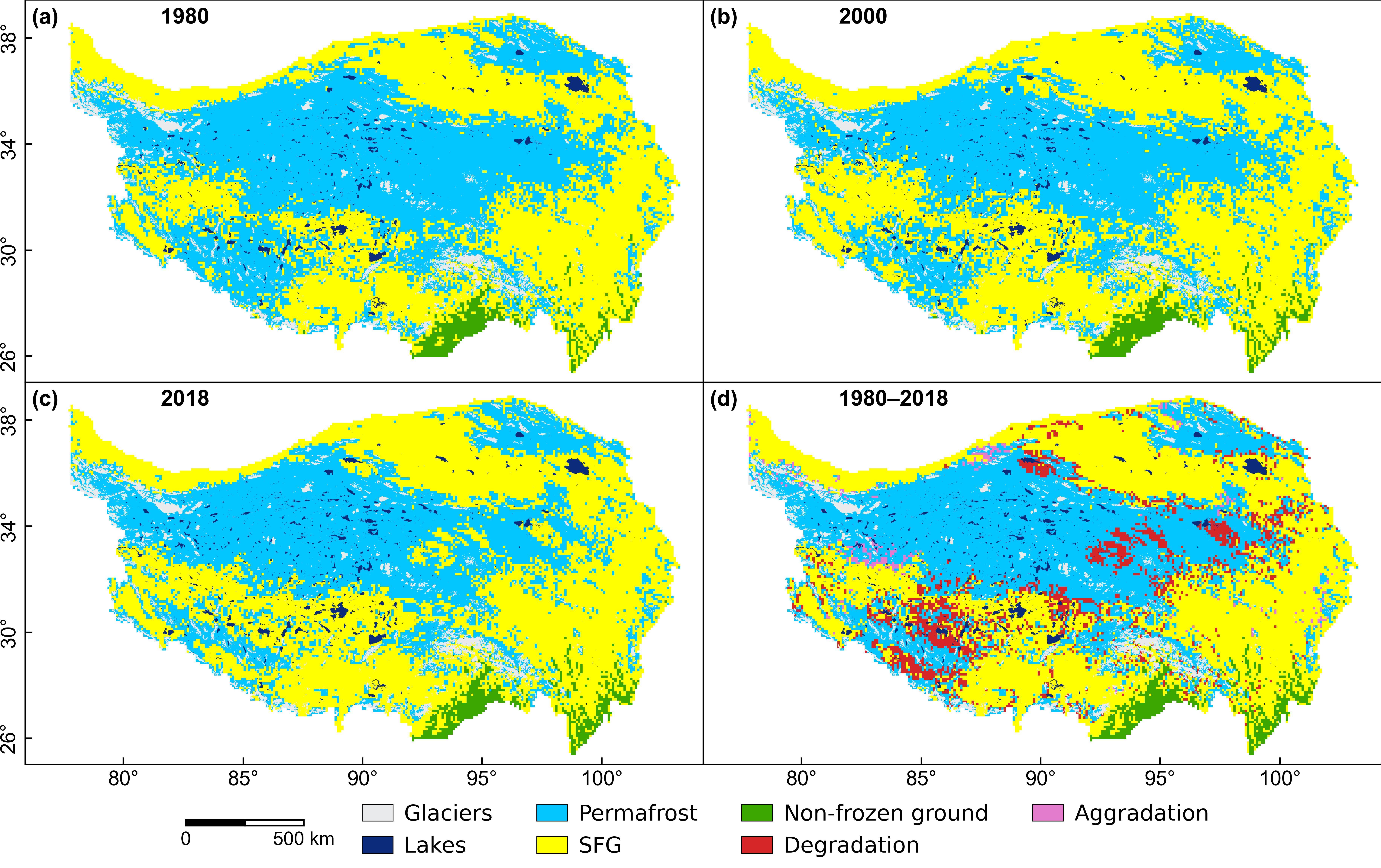
2. Spatial differences: The most severely degraded areas are concentrated on the permafrost margins and sensitive transition zones, especially in the Gangdese Mountains in the southwest and the Sanjiangyuan area in the east.
3. Transient capture: This dataset successfully captured special fluctuations from 2000 to 2005. Affected by the cooling event in the northwest of the plateau in the late 1990s, the permafrost area briefly recovered during this period, which once slowed down the overall degradation process of the region.
The high-resolution permafrost dataset has important application value in climate change impact assessment, regional hydrological and ecological modeling, key ecological protection policy formulation such as Sanjiangyuan, frozen soil stability evaluation of infrastructure such as Qinghai-Tibet Plateau railway and highway, and improvement of land surface process model and global climate model, which can provide key data support for future scenario prediction and adaptation strategy.
This research was jointly funded by National Key R & D Program (2022YFF0711703) and National Natural Science Foundation of China (NSFC)(42571149, 42171125).

Figure 1: Temporal variation of permafrost and seasonally frozen ground (SFG) area on the Tibetan Plateau (1980-2018). Scatter points represent the ensemble mean of simulations, and shaded areas indicate the 95% confidence intervals of 13 ensemble members.The red dots represent the permafrost reference area (108.6 × 10 km²) extracted from the 2010 baseline map.

Figure 2 Spatial and temporal evolution of permafrost distribution on the Tibetan Plateau (1980-2018) (a-c) represent the distribution maps of permafrost and seasonally frozen ground in 1980, 2000, and 2018, respectively.(d) Spatial changes in the permafrost range between 1980 and 2018, focusing on degraded areas (red), emerging areas (pink) and stable permafrost areas (blue).
[Paper citation]
1. Hailong Ji, Xiaobo Wu, Shuping Zhao, Zhuotong Nan*. (2026). Constrained simulation of permafrost thermal changes from 1980 to 2018 on the Qinghai-Tibet Plateau. Global and Planetary Change. 263: 105542 https://doi.org/10.1016/j.gloplacha.2026.105542.
2. Shixian Zhang, Shuping Zhao*, Hailong Ji, Pengfei Li,Fujun Niu, Zhuotong Nan*. (2026). A map-constrained dataset of frozen ground distribution changes on the Qinghai-Tibetan Plateau from 1980 to 2018. Data Express in Arid and Cold Regions. (Under review)
[Data Set Download Address]
https://doi.org/10.12072/ncdc.permalab.db7196.2026