ncdc logo title
2015-2025 high spatio-temporal resolution glacier seasonal flow velocity dataset released in Beascochea Bay, Antarctic Peninsula
Publish time: 2026-05-06 12:55

Recently, the team of researcher Kang Shichang from the Northwest Institute of Ecology, Environmental Resources, China Academy of Sciences released a high-temporal and spatial resolution glacier seasonal flow velocity dataset from 2015 to 2025 in the Beascochea Bay on the Antarctic Peninsula. The paper was published in the International Journal of Applied Earth Observation and Geoinformation journal. The data was published and shared at the National Glacier, Frozen Soil and Desert Science Data Center (www.ncdc.ac.cn), and users can log in to obtain it.

The faster flow velocity of glaciers entering the sea is an important indicator of the dynamic imbalance of the Antarctic ice sheet. In order to clarify the regulation mechanism of the ocean and atmosphere on glacier movement, based on Sentinel-1 satellite observation data from May 2015 to April 2025, researchers systematically analyzed the flow velocity changes of 101 glaciers in the Beascochea Bay on the Antarctic Peninsula, focusing on revealing the key role of warming the upper layer of the bay in accelerating the flow velocity of glaciers.

Research shows that the average summer flow velocity of the Beascochea Bay Glacier increased by 1.81±0.65%, which is about 0.88% higher than the winter average; the maximum summer growth rate is 6.44±0.74%. Since 2018, glacier flow has accelerated on a large scale, with the highest annual growth rate reaching 4.04±0.50% yr ‰. Through analysis of various models, it was found that the warming of the upper ocean at a depth of 0 - 300m in the bay is the dominant factor in the growth rate of glaciers. The continuous acceleration of glacier flow velocity is closely related to the heat input from the shallow subsurface of the ocean, rather than the effect of glacier meltwater. This study further shows that in the context of declining glacier dynamic stability, future ocean thermal forcing can maintain long-term accelerated flow rates, which will intensify the loss of glacier material on the Antarctic Peninsula.

The research was funded by the International Cooperation Project of China Academy of Sciences (121362 KYSB20210024) and the Gansu Province Science and Technology Plan Project (23ZDFA017).

[Paper Information]

Paper address: https://authors.elsevier.com/sd/article/S1569-8432(26)00184-6
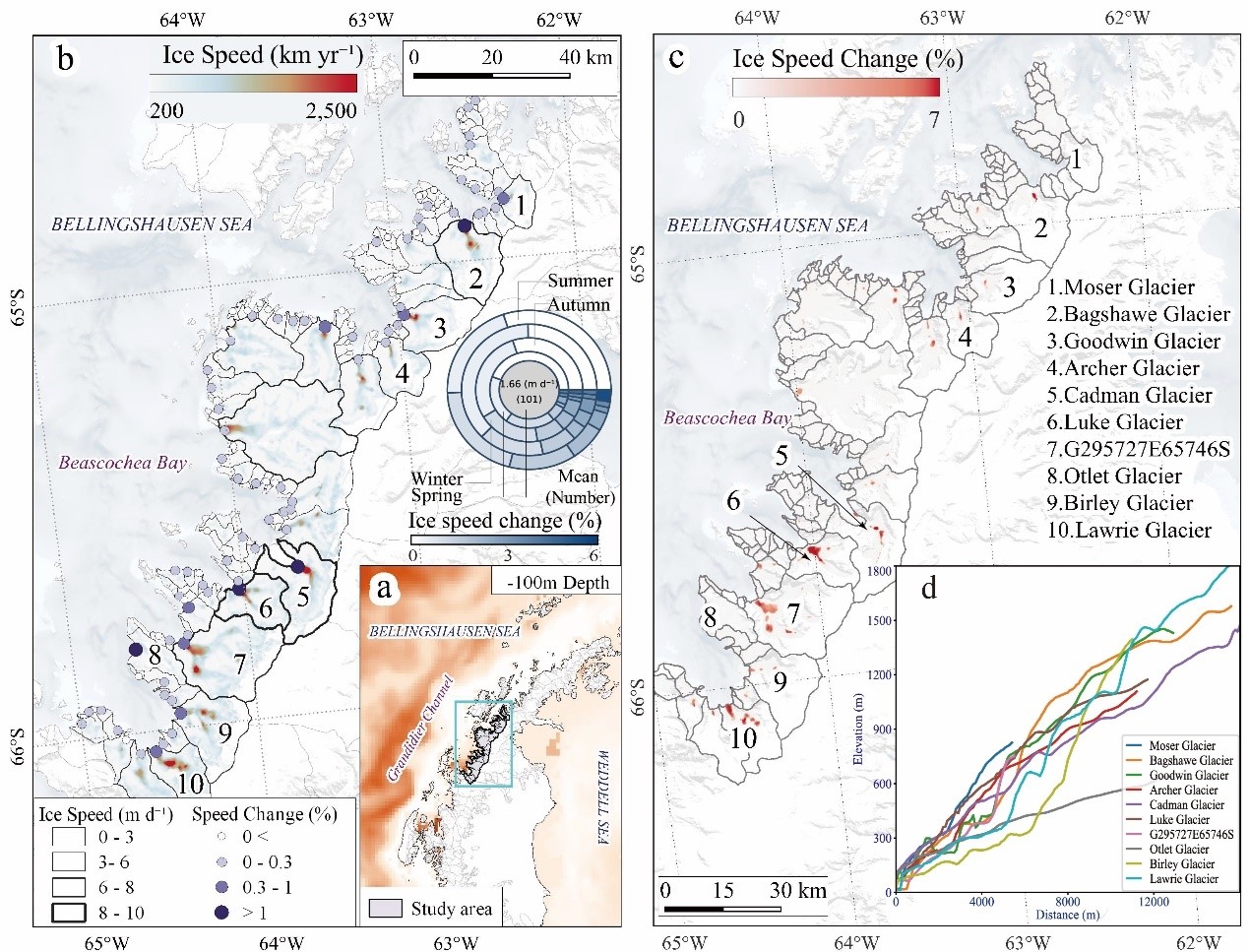

图1 南极半岛Beascochea海湾冰川流速、末端高程与海温变化

[Data download address]

Dataset service address: https://doi.org/10.12072/ncdc.glacier.db7307.2026

Dataset service address: https://www.ncdc.ac.cn/portal/metadata/19f0ac72-4c75-42ce-92d0-022671a6e752